Two Saturdays ago I revisited the Sequalitchew Creek trail at the town of Dupont, north of Olympia and southwest of Joint Base Lewis McChord. I had last hiked the trail five or six years ago, before the second edition of Hiking Washington’s History . This time I led a group from the Pacific Northwest Historians Guild along a former railroad grade bordering Sequalitchew Creek to its outflow into the beautiful Nisqually Reach, co-occupied that day by herons and a seal.
Most of the trail had not changed, but the beginning was a shock. A mountain of uprooted trees, bulldozer tracks, utter devastation greeted us. Hundreds of trees had been cut down, including Douglas fir, western hemlock, western red cedar, Oregon white oak, Pacific yew, Pacific madrone, and big-leaf maple, including landmark trees and at least one culturally modified tree. The trail was bordered by orange construction fielding tape.
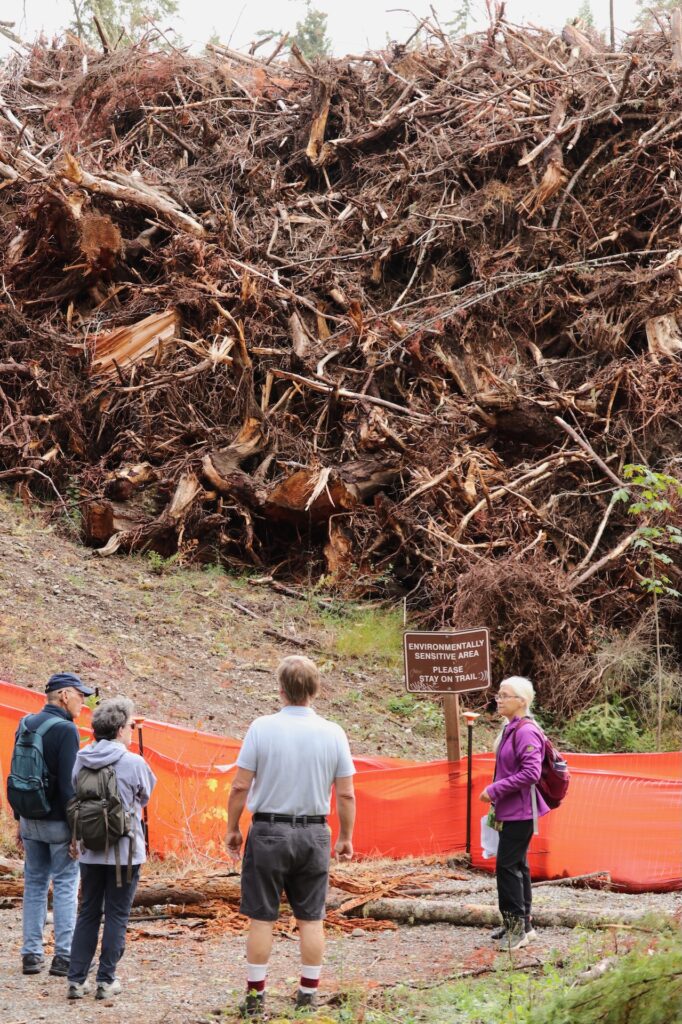
All for what? A warehouse. A 256,800 square foot (five football fields) development with an office/warehouse building, 50 loading bays and 20 acres of impervious surface within 100 feet of the creek, abutting the residential neighborhoods of Northwest Landing.
Why?
My co-guide, Janine Gates, author of Saving the Nisqually Delta, explained, as best can be explained, how this could happen on a stretch of land described by some historians as “reeking of history,” having “wall to wall archaeology,” and “the Plymouth Rock of Washington.”
The Plymouth Rock analogy referenced a Methodic Episcopal mission established on the prairie above the creek, at the site of this destruction. It was the first American settlement on Puget Sound. The site was always a bit hard to find, off a dirt path from the paved creek trail, but a concrete marker said in simple words, “Site of Episcopal Mission established in 1841. At this place the first of July celebration was held in 1841 by Capt. Charles Wilkes of United States Exploring Expedition then anchored off the mouth of Sequalitchew Creek.” The marker was erected by the E.I. Dupont de Nemours & Co. which occupied the land for 70 years from 1906 to 1976. Now it was no longer accessible at all, encased in the distance in more orange tape, which promised to isolate It from the destruction.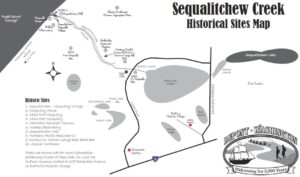
The history of Sequalitchew Creek, Nisqually Reach, and the mission plain was much richer than this marker. As described in a chapter in Hiking Washington’s History, the Sequalitchew-Nisqually lived in a village near the mouth of Sequalitchew Creek and dug camas on this prairie for centuries. They traded….. The British Hudson’s Bay Company built Fort Nisqually, a trading post, on the bluffs above Nisqually Reach in 1833. The Wilkes Exploring Expedition established an observatory on the same bluff to perform soundings of the Reach as it conducted a scientific survey of Puget Sound and inland country; the 4th of July celebration included 100 Marines, British fur traders at Fort Nisqually, Sandwich Island and indigenous employees—with a barbecued ox, horse-racing, and the discharge of two howitzers. Some 2000 soldiers, including the famous Buffalo Soldiers, bivouacked near the creek in 1904, the beginnings of Joint Base Lewis McChord. Then came the Dupont Powderworks which imported sodium nitrate from Chile and exported a billion tons of explosives all over the world. The Sequalitchew Creek Trail follows the narrow gauge railroad grade that carried dynamite to a long dock reaching some 30 feet offshore to water that is 300 feet deep.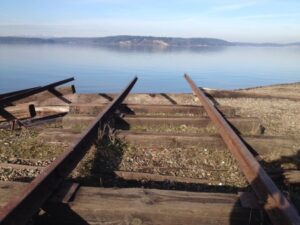
Weyerhaueser bought the land from Dupont. After abandoning a proposal for a log export facility, the company built a golf course on contaminated soil to the south of the creek and the planned community of Northwest Landing on the north side.
An effort to create a federally recognized historic district around Sequalitchew Creek did not succeed. Gates describes in her book the contemporary land use issues facing the creek and the Nisqually Delta, including expansion efforts by CalPortland, a sand and gravel mine. The current developer and destructor of the mission plain is Avenue 55 of Seattle, a company, which ironically describes itself as a “value-drive real estate company.” Its website promises to create “functional and inspiring spaces that elevate the communities we serve.”
Is this what we value? A warehouse for the transportation of goods? Of course, value in the real estate sense means economic value, but what about the value of history?
The land and the creek and Nisqually Reach have always had heavy commercial use. After more than 5000 years of indigenous occupation, more intense use began when the Hudson’s Bay Company set up a storehouse on the beach at the mouth of Sequalitchew Creek in preparation for a trading operation. In January 1836, HBC traders and indigenous traders came from all over to Sequalitchew.; the storehouse tied Sequalitchew to a global market. During the first year of its operations, the HBC acquired 1800 beaver and otter pelts in exchange for goods like tobacco, blankets, guns, ammunition, beads, tools, and traps. In July 1838, the company ship delivered more than 600 sheep, which grazed on the plains above the Readh, eventually expanding to a herd of more than 9,000 sheep and 7000 cattle. Steam vessels carried cured meat as far as Russian ports in Alaska.
The E.I. Dupont de Nemours Company produced more than a billion tons of explosives and gunpowder for sixty years on the bluffs above the creek and exported them from a dock on Nisqually Reach. Then came Weyerhaueser and, yes, an Amazon fulfillment center.
Surely this has been productive land, sometimes powered by the water of Sequalitchew Creek before Fort Lewis altered is flow. Much of this activity left a legacy of contamination, restricting how the land many be used, incentivizing paving.
But a warehouse? Do we value “stuff” so much that we destroy what nature would provide if given a chance? Would not the history, the trees and pileated woodpeckers who frequented them have far more value?


So sad!!